


























Table of Contents
SOC as a Service and MDR: why intervention matters, not just monitoring
In cybersecurity, the interval between threat detection and actual intervention becomes a critical indicator of an organization’s defense capability. Attacks are diversifying, vulnerability exploitation is accelerating, and IT infrastructures increasingly include distributed components, from endpoints and networks to identities, cloud services, and SaaS applications.
In this context, log collection and alert generation are no longer sufficient. Organizations need permanent investigative, isolation, and remediation capabilities integrated into clear operational processes. The SOC as a Service (SOCaaS) and Managed Detection and Response (MDR) services offered by Safetech Innovations meet this need by providing access to specialized technologies, procedures, and teams, available 24/7.
Official data show that cyber threats are an increasingly serious problem for European organizations. The ENISA Threat Landscape 2026 report shows that in 2025, over 48,000 new vulnerabilities identified by CVE codes were published, up 22% from the previous year. In Romania, according to DNSC data, cited in a 2026 government explanatory note, the institution had notified approximately 46,000 critical vulnerabilities associated with IT infrastructures of 3,178 entities across various sectors.
At the same time, the attack surface is expanding. According to Verizon Data Breach Investigations Report 2026, vulnerability exploitation was the initial vector for 31% of the breaches analyzed, and third parties were involved in 48% of them. Monitoring must therefore cover not only internal systems but also digital identities, cloud services, SaaS applications, and vendor interconnections.
Attacks leave less and less time for reaction
Alongside the increase in volume, the speed at which attackers exploit vulnerabilities and move through compromised infrastructures is concerning. According to the Fortinet Global Threat Landscape Report 2026, in the case of critical vulnerabilities, exploitation begins only 24–48 hours after publication. In parallel, the CrowdStrike Global Threat Report 2026 indicates an average time of only 29 minutes between initial access and lateral movement for 2025 in the cybercrime cases analyzed.
These intervals require a change in approach. Vulnerability remediation must be prioritized quickly, and response actions, including system isolation or blocking compromised accounts, must be defined and authorized before the incident occurs. Critical minutes of an attack should not be spent establishing responsibilities and obtaining approvals.
Under these conditions, the effectiveness of security operations should not be evaluated solely by the mean time to detect (MTTD). Equally important are the incident confirmation time, the time to threat isolation, and the time required for remediation and recovery. Indicators such as Mean Time to Respond and Mean Time to Recover (MTTR), clearly defined for each process, provide a more relevant picture of the actual defense capability.
Technology takes over tasks, but does not replace operation
Organizations today have numerous technologies for preventing, detecting, and limiting attacks. System updates, phishing-resistant authentication, the application of least privilege principles, and network segmentation contribute to reducing the attack surface.
Operationally, Endpoint Detection and Response (EDR) and Extended Detection and Response (XDR) platforms identify and correlate suspicious activities, Security Information and Event Management (SIEM) solutions centralize and analyze security events, and Security Orchestration, Automation and Response (SOAR) tools automate repetitive procedures and certain response actions. Some XDR platforms can automatically isolate a compromised endpoint or trigger blocking actions based on predefined rules. This is an important advance, but automatic isolation does not equate to fully resolving an incident.
After limiting the threat, the root cause, affected systems, persistence mechanisms used by the attacker, any lateral movements, and the possibility of data exfiltration must be established. Subsequently, it is necessary to fix exploited vulnerabilities, eliminate compromise mechanisms, and restore systems to safe operation. These activities involve expertise, procedures, and operational coordination.
Artificial intelligence is rapidly changing the way security centers operate. AI models can accelerate alert triage, event correlation, and repetitive investigations. An example comes from Stellar Cyber, which tested the Agentic Auto Triage feature in customer environments over 124 days. In tests that included 138,475 real alerts, the AI’s verdict matched that of analysts in 99.7% of evaluations. The company reports that automatic sorting saved analysts about 19 minutes for each hour of alert work ( Results published by Stellar Cyber ).
These results illustrate the potential for automation, but an automatically closed case does not necessarily mean a stopped attack. AI efficiency depends on the quality of telemetry, integration of data sources, and configuration of response mechanisms. Additionally, AI models can produce misinterpretations, and uncontrolled interventions can affect the availability of legitimate services. Therefore, AI does not eliminate the need for SOC specialists but changes the nature of their work: less time dedicated to repetitive triage and more attention to complex investigations, validation of conclusions, and critical decisions. Automation must operate within well-defined operational processes, with clear responsibilities and intervention limits.
Why requirements for SOC and MDR services are increasing
Beyond evolving threats, organizations must manage budget pressure and the difficulty of recruiting and retaining security specialists. Building a functional 24/7 internal SOC requires significant investments in technologies, personnel, ongoing training, and operational processes.
Another important factor is regulation. The NIS2 Directive and the DORA Regulation impose stricter requirements regarding incident management, operational resilience, event traceability, and reporting. These regulations increase the need for permanent detection, investigation, and response capabilities, as well as records to support compliance.
Outsourcing through SOCaaS and MDR models allows quick access to specialized expertise and permanent operational capacity, without their full internal development within the organization.
Technology developments and economic pressures are leading companies to more carefully evaluate the results of contracted services, especially reducing response times and limiting the impact of incidents.
SOC and MDR services are evolving toward automation with human oversight, extended IT infrastructure coverage, and measurable contractual response. AI will accelerate alert analysis and repetitive investigations, while monitoring will increasingly include cloud components, SaaS, digital identities, and distributed systems. Performance will be evaluated through detection, isolation, and remediation times, based on clearly defined responsibilities and intervention procedures.
For organizations, the main criterion in choosing a SOC/MDR service thus becomes the proven ability to intervene effectively and limit the impact of incidents on operations, surpassing in importance the technologies used or the number of alerts processed.
How does Safetech Innovations respond to these requirements?
Safetech Innovations’ security operations outsourcing services are built to meet these challenges. They are provided by STI CERT, Safetech Innovations’ incident response team, which has been offering SOC services since 2015, with continuous coverage, 24/7/365.
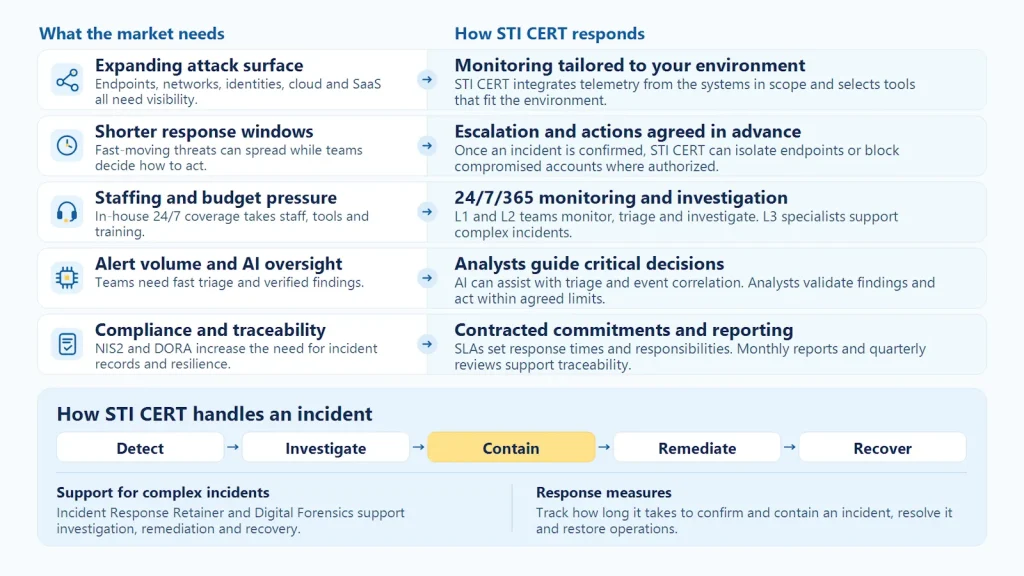
The approach combines continuous monitoring and investigation with escalation procedures and response capabilities, tailored to the architecture and requirements of each organization.
Managed SOC (SOCaaS) / MDR 24/7
Managed SOC and MDR services ensure continuous security monitoring. Threats identified within the agreed perimeter are detected, investigated, and escalated through defined operational processes.
L1 and L2 teams manage the current flow of monitoring, analysis, and investigation, while L3 expertise is available for complex incidents requiring in-depth analysis and specialized intervention. Alerts are analyzed in the context of monitored systems and integrated telemetry sources so that the beneficiary receives relevant information for risk assessment and decision-making.
The operational model follows four essential components:
- Predefined response. Escalation procedures, authorized contact persons, and response actions are established before operation begins, to allow rapid intervention in case of an incident.
- Measurable commitments. Service levels, response times, and responsibility limits for intervention are defined by a contractual Service Level Agreement (SLA).
- Records for compliance. Detailed monthly reporting and quarterly analysis of lessons learned support risk management and incident documentation, including in the context of NIS2 and DORA requirements.
- Flexible model. The service is provided on a recurring basis, on a subscription basis with a minimum duration of six months. The scope, integrated technologies, and operational parameters are adapted to the organization’s requirements.
Beyond monitoring: investigation, response, and remediation
Intervention capacity differentiates a mature SOC service from one limited to monitoring and alert transmission. After an incident is confirmed, identifying the attack vector, assessing compromised systems, analyzing persistence mechanisms, and applying isolation and remediation measures are essential.
Safetech Innovations complements Managed SOC / MDR services with Incident Response Retainer, post-incident analysis, and Digital Forensics, through STI CERT and its own forensic laboratory. Depending on the incident and contractual responsibilities, intervention may include endpoint isolation, blocking compromised accounts, removing persistence mechanisms, and supporting the recovery of affected systems.
The complementary services of Vulnerability Management, Breach and Attack Simulation, Threat Hunting, and Threat Intelligence contribute to proactive risk identification and verification of the effectiveness of security controls.
Operational experience, technologies, and responsiveness
Safetech Innovations services combine the operational experience of STI CERT, which has been providing SOC services since 2015 and is accredited by Trusted Introducer, with technologies tailored to each beneficiary’s infrastructure.
Depending on requirements, the architecture can integrate Stellar Cyber (XDR/NDR/ISOC), Splunk or Microsoft Sentinel (SIEM), Darktrace (NDR), and Cynet (EDR), as well as ThreatEcho, Kela, and MISP for Threat Intelligence. Solutions are selected based on the client’s technological environment, without imposing a single platform.
Activities, deliverables, response times, and responsibilities are contractually established so that the beneficiary knows exactly the intervention conditions. STI CERT’s experience includes managing critical incidents, including ransomware attacks, with the support of the Safetech forensic laboratory. Through these skills, Safetech Innovations can ensure an integrated process of detection, investigation, response, and remediation, complemented by proactive measures for continuous security improvement.
The value of a SOC is measured by its intervention capacity
Today, the value of a SOC service is no longer measured solely by the number of alerts generated or transmitted to the beneficiary. Relevant indicators are the time needed to identify and isolate threats, the operational impact avoided, the efficiency of remediation, and the quality of the evidence provided. In a context where attacks are accelerating and infrastructures are becoming increasingly complex, services that combine continuous monitoring with investigation and authorized intervention become essential.
Safetech Innovations offers this integrated approach through 24/7 Managed SOC / MDR services and specialized Incident Response and Digital Forensics capabilities, backed by STI CERT’s experience gained since 2015.
In 2026, Safetech Innovations ranked 151st globally – first among Romanian suppliers – in the Top 250 MSSPs ranking, compiled by MSSP Alert and CyberRisk Alliance. This is the company’s third consecutive presence in this ranking of managed cybersecurity service providers. Its presence in this ranking reflects the continuity of Safetech Innovations’ activity in managed cybersecurity services and investments in developing technical and operational capabilities. Details about Top 250 MSSPs 2026.
Would you like to find out how a Managed SOC / MDR service can be adapted to your organization’s infrastructure and risks? Contact us at office @ safetech.ro to jointly define the monitored perimeter, technologies, intervention procedures, and the appropriate SLA.