



























Table of Contents
Less noise, more clarity: AI for the SOC analyst
The increase in the number of monitoring and security platforms has led to an explosion in the volume of alerts, making alert fatigue one of the biggest challenges for SOC teams. Artificial intelligence is changing the paradigm, shifting the focus from simply detecting events to correlating, contextualizing, and prioritizing incidents that really require the intervention of an analyst. Safetech’s experience shows how this approach reduces operational noise without eliminating the essential role of the SOC specialist. In a modern IT infrastructure, the challenge is no longer the lack of data, but the excess of it. Monitoring, observability and security platforms generate thousands, sometimes tens of thousands, of alerts every day, and the teams responsible for the operation of digital services must quickly decide which of them describe real incidents and which are notifications with no operational impact. The phenomenon, known as alert fatigue, has become one of the most pressing challenges for both IT operations and cybersecurity.Noise increases with the number of platforms
Paradoxically, the more monitoring and security solutions an organization implements, the more the problem intensifies rather than diminishes. Today, a company may use dozens of platforms—observability, Application Performance Monitoring, infrastructure monitoring, log analysis, and security—each generating its own stream of notifications. A single incident can trigger dozens of alerts across different systems at the same time, without those alerts being automatically correlated. The result is an avalanche of signals that, in reality, describe the same problem from different perspectives. The impact can be seen in the numbers. According to the INOC 2026 Event Correlation Guide, a service provider that manages about 700 pieces of equipment can receive more than 35,000 events per week, and during maintenance periods the volume can increase by another 300–400%. In such a flow, critical alerts risk being buried under a mountain of notifications with no clear priority, and teams inevitably end up with operational burnout. Alert fatigue also remains a critical operational challenge for security operations centers (SOCs). The 2026 edition of the SANS SOC Survey shows that these teams face alert volumes that frequently exceed 2,900 per day, and a significant part remains untreated due to the high rate of false positives, which can reach up to 53%. Basically, more than half of the triage effort is spent on alerts that do not ultimately describe a real incident. The study also draws attention to a fundamental change: the big challenge of SOC centers is no longer the lack of people, but the skills shortage and the difficulty of transforming huge volumes of alerts into business-relevant incidents. Many organizations continue to measure SOC performance by the number of incidents processed — a decade-old metric that says a lot about volume and little about the actual value it brings to the organization. The two perspectives describe, in essence, the same reality. In the IT area, alerts come from monitoring applications, infrastructure, cloud services or external dependencies. In cybersecurity, the sources are SIEM, XDR, EDR, firewalls, IDS/IPS, identity platforms and threat intelligence. The nature of the signals differs, but the effect is identical: overloaded teams, increasing response times and the risk that the important incident will be noticed too late.From detection to correlation and prioritization
The context described leads to a shift in focus in the industry: from simply detecting events, to intelligently correlating and prioritizing them. The role of artificial intelligence is not to generate even more alerts, but to reduce operational noise, eliminate duplicates, add context and highlight incidents that really require the intervention of a specialist. The new generations of XDR, AIOps and Managed Detection and Response platforms are built on this principle: transforming thousands of notifications into a small number of relevant, investigated and prioritized incidents.How Safetech manages the volume of alerts: centralizing telemetry
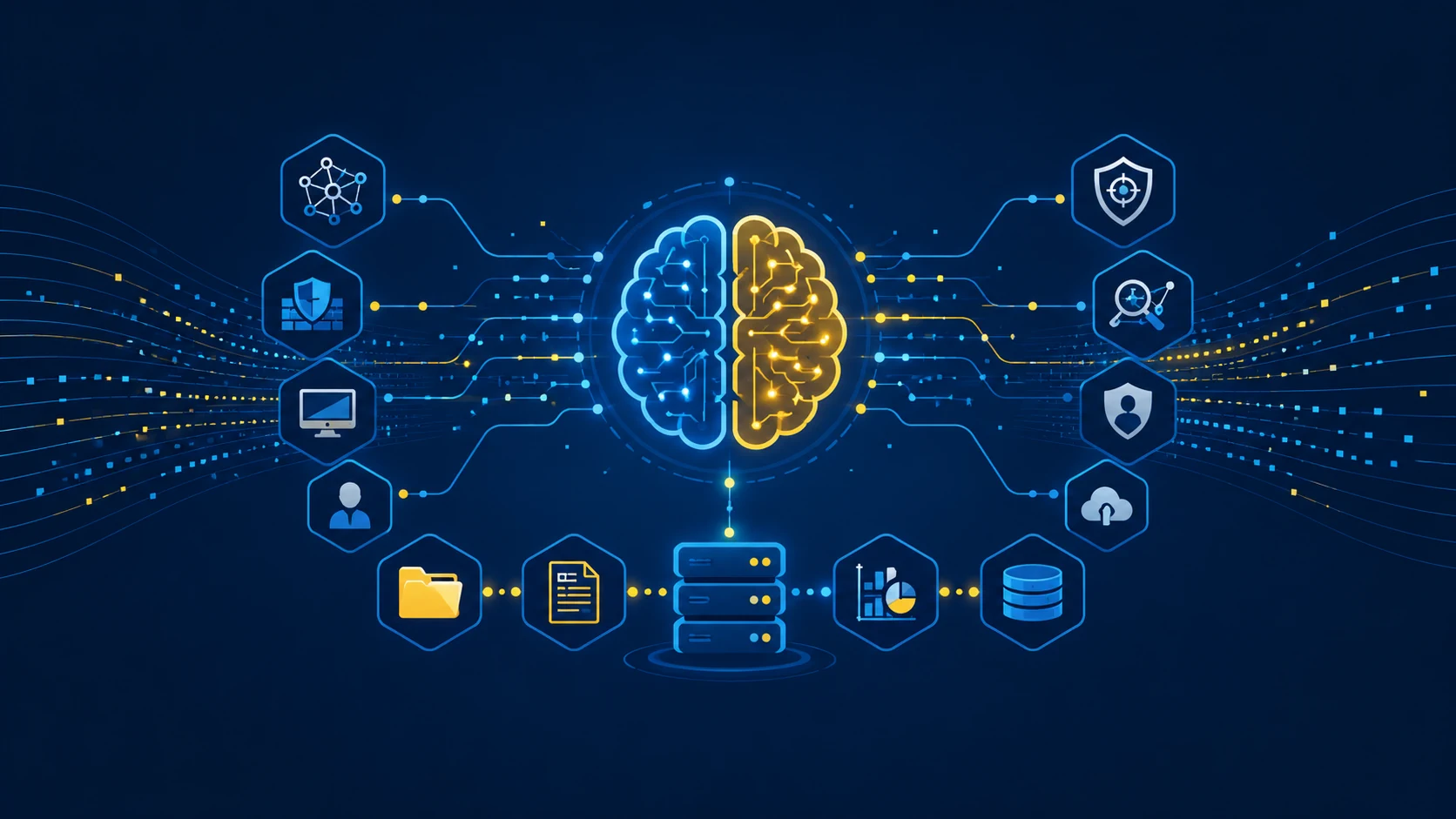
For the Safetech team, noise reduction starts with the automatic centralization of telemetry. The Safetech Managed Detection and Response (MDR) service aggregates data from several categories of sources — network traffic, firewall, IDS/IPS and VPN logs, endpoint data, on-premises and cloud Active Directory identity information. The SOC architecture uses the Stellar Cyber, Cynet and Darktrace platforms for centralization, context enrichment and correlation, and the indicators of compromise — IP addresses, hashes — are also validated through threat intelligence sources. An isolated alert rarely tells the whole story. In Safetech MDR , data from the network, endpoint, identity, and cloud are put together, and indicators of compromise are checked against external sources. The analyst no longer starts from a singular signal, but from a case already enriched with the relevant relationships and evidence — the difference between a raw alert and a contextualized incident.AI for preliminary investigation, final decision to analyst
In the Safetech SOC, AI-based tools do a preliminary screening, and specialized L1–L3 teams take over, analyze, treat, and escalate real incidents. SIEM/XDR platforms integrate data from multiple sources, enrich it with context, use UEBA capabilities for finer filtering and, where appropriate, SOAR functionalities for rapid response. The workflow is semi-automatic and follows a few clear steps: alerts are automatically picked up and analyzed; A local AI application gathers contextual information and conducts a preliminary investigation to facilitate triage and provide the analyst with reasoned results and recommendations. SOC analysts then do the detailed investigation, and the final decision — false positive, confirmed incident, escalation or immediate response — is up to the specialist. The AI Safetech SOC Triage app takes care of this first step: it automatically gathers the relevant context and performs the preliminary analysis, while the SOC specialist makes the decisions to classify and treat the case. Basically, the model takes out of the equation the repetitive work of manual information collection, without eliminating human control from impactful decisions. The same app helps the team determine the order of investigations by categorizing alerts by severity levels and adding the necessary context — the goal is not just a lower number of visible alerts, but to quickly direct analysts to cases with high potential impact. AI does not replace the analyst; it sets the context for him and leaves his attention free for cases that really require human judgment.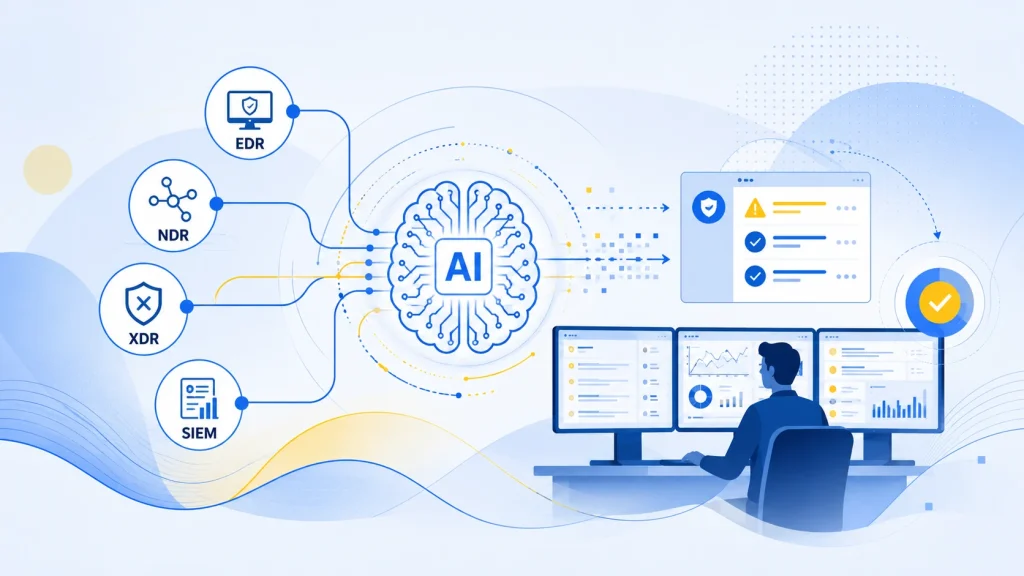
Tuning, human validation and knowledge of the customer’s environment
Noise reduction does not mean ignoring alerts, but a controlled process of tuning and validation. Recurring and legitimate activities in each client’s environment are identified, verified and entered into the whitelisting rules of the SOC platforms, so that analysts do not waste time reinvesting, day after day, the same benign behavior. This combination — platform tuning, human validation, and in-depth knowledge of the customer environment — is what makes AI implementation work in practice, not just on paper.
Contextual Risk Score
The Safetech ThreatEcho platform uses AI to discover external threats, monitor vulnerabilities in customers’ IT infrastructure, deduplicate and correlate signals from different sources, and assign a contextual risk score. The outcome is not an even longer list of alerts, but a list of prioritized incidents, accompanied by technical context, evidence, and remediation recommendations.
|
Funcționality |
Content |
|
Telemetry centralization |
Aggregate data from network, firewall, IDS/IPS, VPN, endpoint, and identity (AD on-prem/cloud) into a single stream |
|
Stellar Cyber, Cynet, and Darktrace Correlation |
Enriches and correlates signals, turning the isolated alert into a contextualized case |
|
Validation with external threat intelligence |
Check indicators of compromise (IP addresses, hashes) against external sources |
|
Safetech SOC Triage (AI) |
Do the preliminary investigation, gather context and recommend the classification, before the analyst |
|
Classification by severity |
Sorts alerts by potential impact, guiding analysts to priority cases |
|
Tuning and whitelisting |
Eliminates repeated re-investigation of recurring and legitimate behavior specific to the customer’s environment |
|
ThreatEcho (Contextual Risk Score) |
Deduplicates and correlates signals from different sources, assigning a risk score per incident |
|
UEBA / SOAR (in SIEM/XDR platforms) |
Fine behavioral filtering and response automation for repetitive cases |
Implications for NIS2 and DORA
Reducing alert fatigue is not only a matter of operational efficiency, but also a compliance topic. Both NIS2 and DORA emphasize rapid incident detection and the organization’s ability to respond within strict deadlines. A team that gets lost in the volume of alerts is less likely to identify and report a significant incident within the time window imposed by regulation. For this reason, reducing operational noise through AI and automation is no longer just a competitive advantage, but becomes concrete support for meeting NIS2 and DORA requirements.
From telemetry to operational decisions
In Safetech’s experience, the role of artificial intelligence within a SOC is not to replace the specialist, but to increase its efficiency. AI collects and correlates telemetry from multiple sources, eliminates duplicate alerts, adds context, and supports incident prioritization. However, the SOC analyst remains the central element of the process, validating the conclusions, assessing the impact on the organization and establishing response measures. The value of AI is not in detecting a larger number of events, but in turning a massive volume of telemetry into a small number of relevant, contextualized, and prioritized incidents.
The results of this approach are also visible at the operational level. Within the CERT TSI, more than 100 billion events are processed monthly, resulting in approximately 25,000 alerts analyzed and around 180 incidents managed. These figures illustrate how automation, intelligent correlation, and the expertise of SOC analysts are turning huge volumes of raw data into a small number of incidents that organizations can act on quickly and efficiently.
For more information about the Safetech MDR service and outsourcing of security operations, contact us at [email protected].
FAQs
1. What does alert fatigue mean?
The fatigue caused by the high volume of alerts generated daily by monitoring and security platforms, which makes it increasingly difficult to distinguish real incidents from non-impact notifications.
2. How does AI reduce the number of relevant alerts in a SOC?
By correlating signals from multiple sources, removing duplicates, and adding context, AI turns thousands of raw alerts into a small number of incidents prioritized for investigation.
3. Does AI replace SOC analyst?
No. AI does the preliminary investigation and provides context, but the final decision — false positive, confirmed incident, escalation — always remains with the analyst.
4. What does alert fatigue reduction have to do with NIS2 and DORA?
Both regulations require rapid incident detection and response; reducing operational noise helps organizations meet imposed reporting deadlines.