




























ThreatEcho – Safetech Innovations’ answer to the expansion of the modern digital attack surface
In recent years, cybersecurity teams have had to manage an increasingly complex reality: attacks no longer come from a single perimeter, and the “border” between the internal and external environments has become, in practice, irrelevant. In this context, Safetech Innovations has developed ThreatEcho, an integrated platform for automatic digital risk analysis and reduction, designed to respond to this operational fragmentation.
Based on the hands-on experience of the Safetech Innovations team and the analysis of more than 15 billion monitored breach records, ThreatEcho delivers a high level of operational performance, including up to 90% reduction in false positives, 24/7 automated protection, and up to 10x faster response time.
This performance is not the result of a simple extension of the classic dark web monitoring model. Unlike traditional solutions, which are limited to generating alerts, ThreatEcho combines unified visibility with contextual intelligence and automatic remediation capabilities, turning raw signals into concrete and prioritized security actions.
Why we developed ThreatEcho
The motivation behind ThreatEcho is a pragmatic one, derived from the operational realities of modern SOCs:
- Exponential increase in the volume of security alerts; 73% of organizations consider false positives to be the main challenge in threat detection, which represents a significant increase compared to the previous year (SANS 2025 – Detection and Response Survey).
- Lack of correlation between different tools (SIEM, EDR, vulnerability scanners, dark web monitoring), in Romania companies using an average of 35 security tools (EY – Emerging Technology Investments in Romania)
- Increase in attacks based on compromised credentials;
- The difficulty of real prioritization of exploitable vulnerabilities;
- Response Time Pressure (MTTR).
In practice, many organizations end up with a high level of visibility, but a limited understanding of the real risks. ThreatEcho was built exactly to reverse this situation: fewer alerts, but more relevant, better contextualized and, where possible, automatically remediable.
ThreatEcho is more than just dark web monitoring
ThreatEcho starts by correcting a common perception in the market: the idea that threat intelligence essentially means dark web monitoring. In reality, this approach is just one piece of a much larger picture. The real value of the platform appears when the risk is no longer seen in isolation, but correlated between several layers of digital exposure.
Stealing credentials, for example, doesn’t say much on its own if it’s not correlated with active identities in Microsoft 365. A CVE vulnerability may seem critical on paper, but its real relevance only appears when analyzed in relation to the technologies actually used in the organization’s infrastructure. Similarly, a fake domain only becomes a concrete threat when connected to an active phishing campaign.
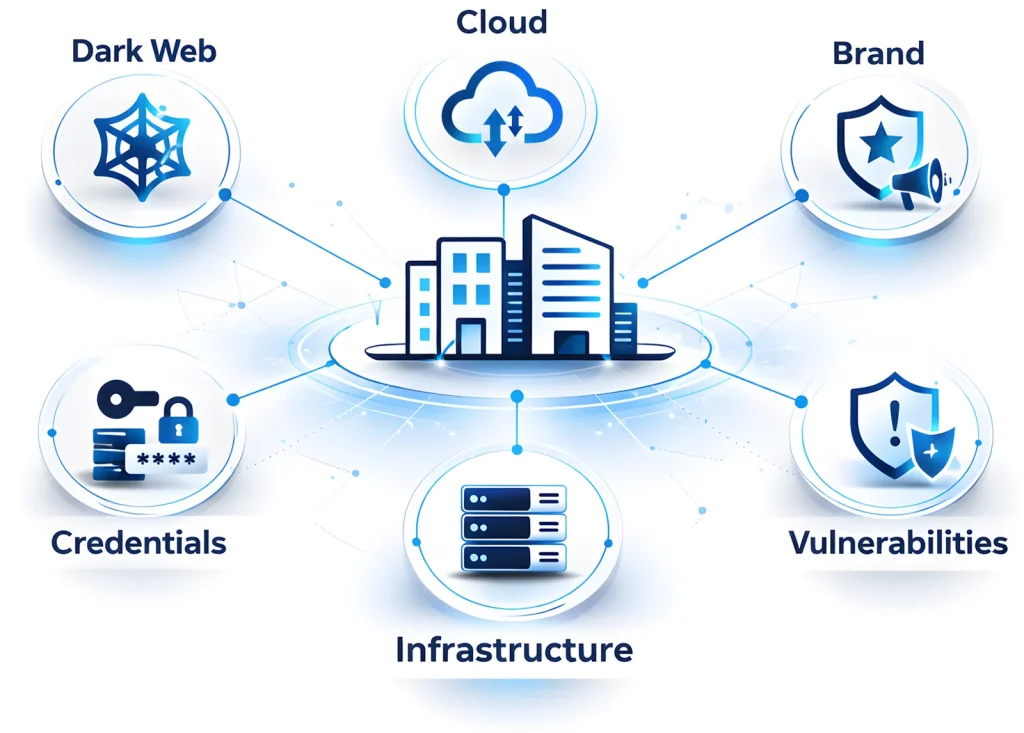
On this correlation logic, Safetech has built the four pillars of the platform, which define the complete coverage area and reflect the main functionalities:
External threat analysis
- Dark Web and Marketplace Monitoring
- Detection of compromised credentials (including clear text passwords)
- Threat Actor Tracking
- Automatic scans several times a day.
Technology Risk Analysis
- CVE and zero-day continuous scanning
- EPSS (probability of exploitation) prioritization
- Correlation with the real technology stack
- NIST NVD integration.
Brand and digital identity protection
- Typosquatting domain detection (DNSTwist)
- Homoglyph variations and TLD spoofing
- Logo impersonation monitoring
- Similar domain registration alerts.
Internal security posture analysis (Microsoft 365)
- Identity Security Assessment
- Tracking MFA adoption
- Device compliance
- Password Reset and Session Revoke Automation
- Conditional Access policy enforcement.
This functional structure moves the ThreatEcho platform from the area of passive observation to the area of proactive security intervention.
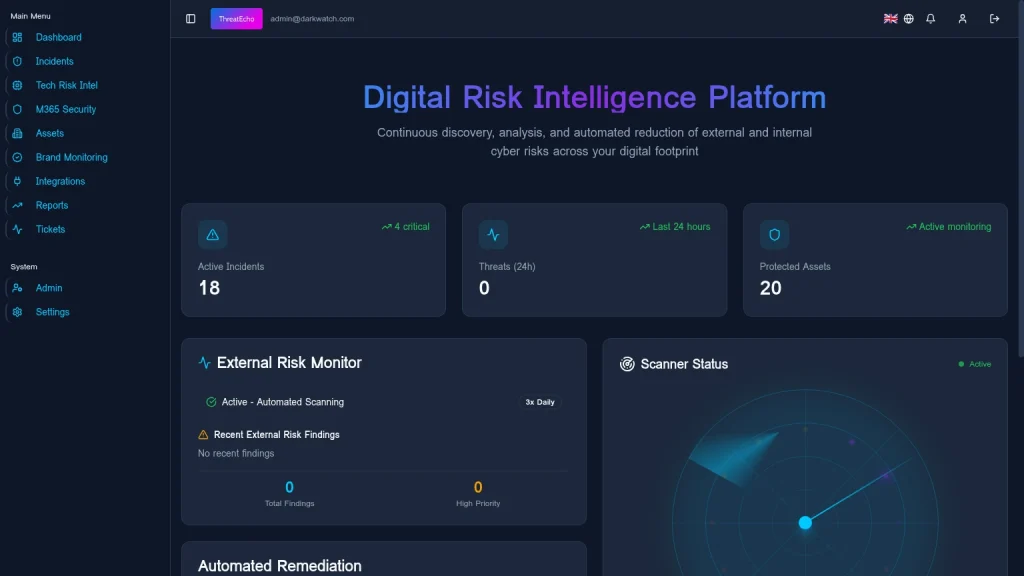
How the solution works in practice
ThreatEcho is built around an operational flow that starts from a simple idea, but difficult to implement in practice: effective security does not mean more alerts, but more context and faster reaction.
It all starts with defining the organization’s digital footprint. At this stage, the relevant assets are introduced – domains, IPs, email addresses, Microsoft 365 infrastructure components, but also the technologies used or brand elements. Basically, the platform builds an initial image of what needs to be protected.
From here, ThreatEcho enters a continuous monitoring cycle, with multiple scans per day. The sources are diverse and cover both the public space (OSINT) and less accessible areas such as the deep web and dark web, along with feeds of CVE vulnerabilities and domain monitoring or impersonation attempts.
The collected data is not treated individually, but goes through a correlation layer based on artificial intelligence. At this stage, the platform removes duplicates, links signals to each other, and assigns them a contextual risk score, based on the actual relevance to the organization.
The result of this process is a list of incidents already prioritized, not a raw collection of alerts. Each incident comes with a severity level calculated on impact, technical context, and evidence, along with remediation recommendations.
In some cases, the process continues beyond analysis and reaches direct action. ThreatEcho can automatically trigger responses such as resetting passwords, revoking active sessions, enforcing policies in Microsoft 365, or initiating predefined security flows.
The essential element that connects the entire system is the reduction of operational noise. Through correlation and deduplication, the volume of false positives decreases significantly, which fundamentally changes the way SOC teams spend their time: less triage, more investigation on real incidents.
Challenges vs. how to solve them
| ❌ The traditional challenge | ✅ The ThreatEcho Approach |
| Isolated security tools without unified visibility | Single pane of glass for external and internal risks|
| Alert fatigue and high volume of false positives | AI deduplication + confidence scoring (reducere zgomot noise reduction of up to 90%) |
| Dark web alerts without concrete action | Credential displays with clear context and clear text passwords |
| CVE manual tracking | Automation + EPSS scoring + stack correlation |
| Lack of executive visibility | HVE tracking + business-oriented risk scoring|
| Slow Incident response | M365 Automation (reset, revoke, lockout) |
| Generic threat feeds | Contextual intelligence tailored to the organization |
| Lack of brand protection | Typosquatting + impersonation + domain monitoring |
| Lack of progress measurement | Risk trends + benchmarking |
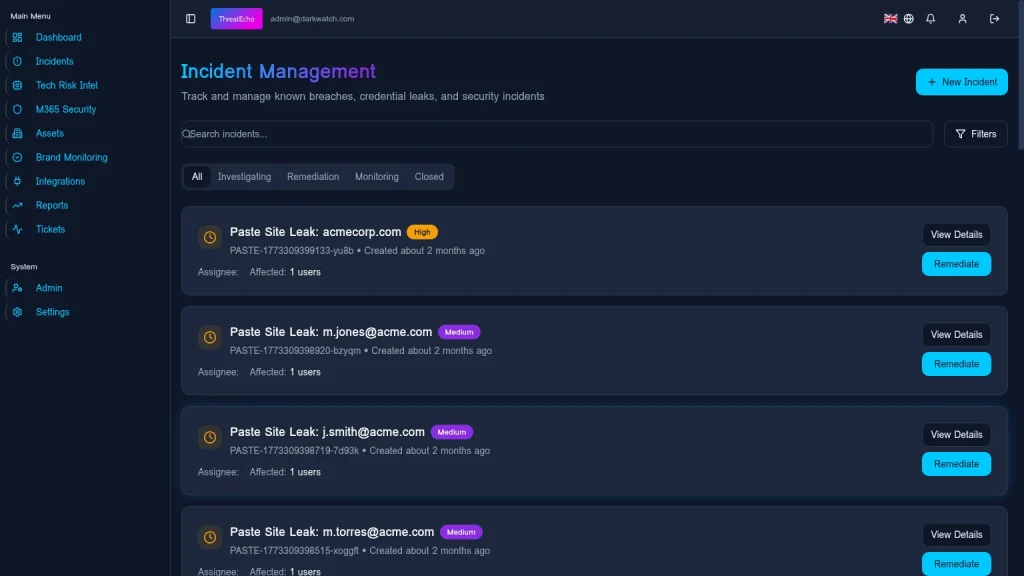
What companies actually gain
The adoption of a platform like ThreatEcho has immediate positive effects at an operational but also strategic level. The real benefits are:
- Reduce SOC overhead by intelligently filtering alerts;
- Faster reaction time thanks to the automation of critical remediation actions;
- Unified visibility into digital exposure;
- Faster detection of real attacks, before exploitation;
- Better business-security correlation through contextual risk scoring;
- Improving compliance (audit-ready reporting);
- Reducing the risk of identity compromise;
- Digital reputation protection.
An important aspect is the transition from a reactive model to a preventive one. Instead of responding to incidents, organizations begin to anticipate and neutralize them before the impact.
Licensing and availability
ThreatEcho is aimed at any organization, public or private, that is experiencing alert overload, lack of context, and the need for operational efficiency and resilience.
The platform is available in a flexible cloud subscription model, tailored to both SMB and medium-sized and large organizations. For the SMB segment, the Basic plan is available, which allows monitoring of up to 15 keywords. The Professional plan allows for advanced customization, asset volume scaling, and integration into complex environments.
The solution is also available as an additional option in Managed Detection and Response service packages and Security Operations Center outsourcing services provided by Safetech Innovations.
More details are available on the official website: https://threatecho.io/ .
In either package, ThreatEcho brings an important shift in the way cybersecurity is understood: from a collection of disparate tools to a unified platform for decision and action.
By combining external threat intelligence, vulnerability analysis, brand protection, and Microsoft 365 security into a single operational flow, the Safetech solution moves the discussion from the monitoring to the risk automation area.
For more information about ThreatEcho, one-on-one presentations, and demos, you can contact us at sales @ safetech.ro .