



























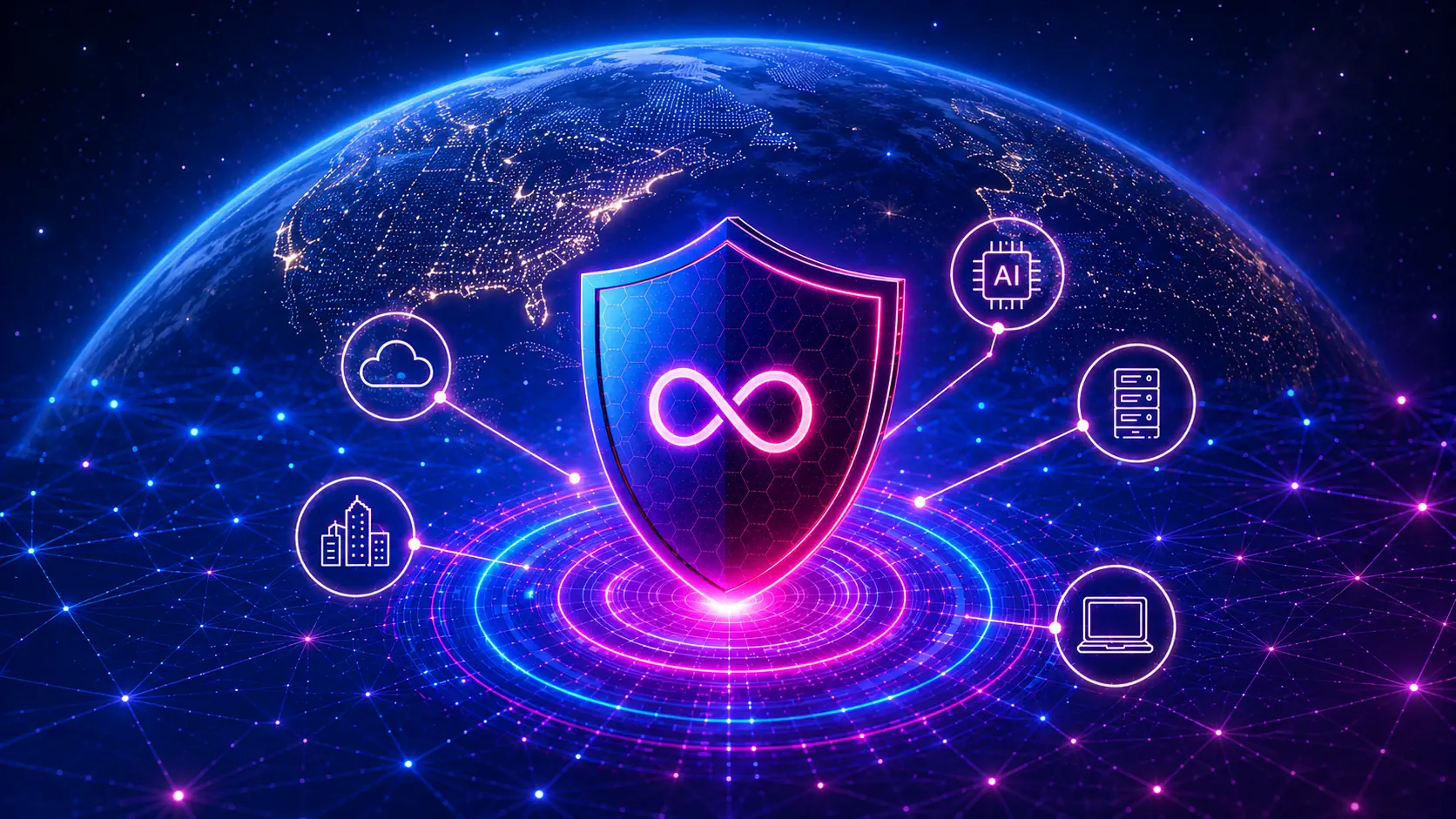
Webinar Safetech – Check Point: Hybrid Mesh Security, trecerea de la soluții fragmentate la o arhitectură elastică și rezilientă
As traditional security approaches increasingly reach their limits, cybersecurity teams must embrace innovation to remain effective. This was the central theme of the webinar “Hybrid Mesh Security in the AI Era”, organized by Safetech Innovations in partnership with Check Point on June 8. Bringing together the insights of two industry experts, the event offered both an in-depth look at the latest technological advancements and a pragmatic perspective on the operational challenges organizations face today.
Redefining Scalability and AI Management with Check Point
Christos Stavrogiannis, Team Leader Security Engineering for Greece, Cyprus, Bulgaria and Romania at Check Point, opened the session by focusing on the new threat landscape of 2026. With a history of more than 30 years in cybersecurity, protecting more than 100,000 organizations in more than 165 countries and blocking 4.6 billion attacks annually, Check Point bases its new strategy on 4 essential pillars:
• Hybrid Mesh: Concept that brings together all solutions related to network security, whether it is physical firewalls (on-premises), cloud firewalls, WAF or SASE solutions. All of this is now integrated under the umbrella of Hybrid Mesh Security.
• Workspace Security: This pillar focuses on endpoint security and includes EDR and XDR solutions, device security and, of course, top-of-the-line Check Point technology for email protection.
• Exposure Management: This is a relatively new area in Check Point’s portfolio, developed in the last two years. It was built around the acquisition of Cyberint and complemented with internal innovations. The result is a complete CTEM (Continuous Threat Exposure Management) solution.
• AI Security: The last pillar is entirely dedicated to protecting the effective use of artificial intelligence within an organization. It aims both to secure the AI tools used by employees on a daily basis, and to protect AI-based applications developed in-house by companies.
“Check Point’s mission is to secure the AI Transformation process, and in this endeavor we support our customers in the most efficient way possible. Check Point solutions offer unparalleled flexibility and allow dynamic adaptation to changes in IT infrastructure or organizational requirements. At the same time, AI-based management tools save time in reviewing security policies and help analysts with useful recommendations and insights,” said Christos Stavrogiannis.
What does Hybrid Mesh Security mean and why is it needed?
Hybrid Mesh Security is a unified architecture that integrates different control points — from traditional data centers and territorial offices, to public/private cloud environments and remote users (through SASE solutions).
According to the Check Point expert, this approach is mandatory in the age of AI because modern attacks exploit the lack of cohesion between isolated tools. Unifying management under a single AI-powered umbrella eliminates blind spots and drastically reduces incident response time.
Check Point’s innovations for flexible infrastructures:
• Maestro Hyperscale: The only solution in the industry that enables a linear expansion of performance by adding new active-active gateways (up to 52 devices and 1.5 Terabits per second throughput) managed as a single object. The technology allows the creation of Security Groups (dynamic logical segmentation) ideal for scenarios with massive traffic peaks (e.g. Black Friday), where security resources can be temporarily reallocated without downtime.
• Elastic XL: A new clustering technology derived from Maestro code, dedicated to smaller deployments (up to 3 members per site or 6 in dual-site configurations), but eliminating the need for a hardware orchestrator. All nodes are active (N+1 configuration), and synchronization is done automatically, software-based, using only one IP address per interface.
• Virtualizarea cu VS Next: The new generation of virtual systems radically simplifies administration. Unlike previous technology (VSX), virtual instances are created directly from the Web UI, CLI, or API in less than a minute, align seamlessly with Maestro and Elastic XL, and allow virtual firewalls in the same physical cluster to be managed by completely different management servers.
The current operational reality calls for a change of perspective
In the second part of the event, Mihai Răuță, Manager of the Security Solutions department, Safetech Innovations, made the transition from the raw capabilities of technology to the way organizations succeed, or fail, to put them into practice.
In the age of AI, security solutions offer clear advantages: a distributed and flexible architecture, unified protection, advanced automation, and expanded visibility. However, the reality on the ground shows that simply acquiring technology, even top ones, is not enough.
“AI-powered security solutions offer a flexible architecture, unified protection, and advanced automation. However, their presence does not automatically guarantee security. The systems themselves are not enough; along with these, functional processes and trained personnel are needed to maintain a resilient infrastructure” , said Mihai Răuță.
Moving from multivendor solutions to a functional architecture
Many organizations suffer from the “fragmented systems” syndrome, operating a multivendor ecosystem where components do not communicate with each other, generating redundant alerts and operational fatigue (alert fatigue) for IT teams.
The current challenge is to transform this fragmented puzzle into a resilient cyber defense architecture. This is achieved by:
• Smart integration: Moving to unified platforms (such as the Check Point ecosystem) or using automation tools;
• Clear operational processes: Exact definition of alert, escalation and automated incident response flows (correlation of alerts through AI Ops and Policy Insights tools);
• The human factor: Configuring, updating and constantly monitoring is up to the administrators. Without a well-trained staff that understands the signals provided by AI assistants, even the most advanced technology remains just an unused investment to its full potential.
How do we stay one step ahead of the attackers?
The webinar highlighted an obvious truth for 2026: security can no longer be static. By combining the flexibility of elastic architectures (Maestro, Elastic XL) and the analytical capabilities of AI from Check Point with the integration expertise, strict processes, and management provided by Safetech Innovations, organizations can make the transition from a reactive posture to a dynamic, adaptive, and truly resilient defense infrastructure.
The full recording of the webinar “Hybrid Mesh Security in AI Era” can be watched below:
To stay up-to-date on the latest cyber defense strategies, technical analysis, and industry best practices, follow Safetech Innovations’ communication channels to discover other webinars held regularly.