




























Table of Contents
What does Hybrid Mesh Security mean and what problems does it solve?
The IT infrastructure of modern companies is distributed on several simultaneous layers: own servers hosted at headquarters or in colocation, public cloud platforms (AWS, Azure, Google Cloud), multicloud environments, branches connected via SD-WAN, remote employees and a growing number of IoT and OT devices. Each of these layers generates traffic, stores sensitive data, and represents a potential attack vector. And attackers have already understood this reality better than security teams sometimes do.
According to IBM’s 2024 Cost of a Data Breach report, but still valid as logic, breaches involving data distributed across multiple types of environments — combining, for example, public cloud with on-premises infrastructure — were more common than those involving a single environment: 40% of incidents affected mixed environments, compared to 25% that targeted only the public cloud and 20% targeted on-premises infrastructure. The practical conclusion is that where the architecture is fragmented, attackers have an advantage.
This reality is also found in Romania, and the answer that Safetech Innovations proposes does not come from a new product or from an additional functionality added to an old system. It comes from a fundamental rethinking of network security architecture — and this is the essence of the concept of hybrid mesh security.
What is hybrid mesh security?
Hybrid mesh security — or hybrid mesh network security, in its extended formulation — is a security architecture that unifies the protection of on-premises infrastructure with cloud-native security, under a single, centralized point of control. Unlike traditional models, where each segment of the network is protected by its own, separately managed solution, hybrid mesh architecture treats the entire infrastructure — no matter where it is physically or logically located — as a unified network, governed by coherent policies and complete visibility.
The definition is not abstract. Specifically, a hybrid mesh architecture allows IT and security teams to enforce and manage common security policies across data centers, multicloud environments, and remote users, without duplicating effort and without accepting blind spots generated by the transition from one environment to another. This includes direct and flexible connectivity between security enforcement points — cloud Points of Presence (PoPs), agents installed on on-premises devices, and equipment — eliminating reliance on a single central hub and ensuring faster, more efficient routing.
It is important to understand that hybrid mesh security is not a singular product, but an architecture — a design philosophy in which multiple forms of security implementation (hardware, virtual, cloud-native, cloud-delivered, Kubernetes containers, firewall-as-a-service) are orchestrated as a coherent system. Its most concrete form in the security market is the hybrid mesh firewall (HMF) — the platform that materializes the architectural principles of the model.
Why did this architecture become necessary?
Siloed security models—where on-premises firewalls operate independently from cloud-native controls, without a unified management and visibility framework—were adequate when infrastructures were largely homogeneous and static. In today’s hybrid and highly dynamic environments, however, this fragmented approach introduces at least three fundamental challenges that directly weaken the organization’s overall security posture.
The first problem is the fragmentation of visibility. When one NGFW handles traffic in the data center, another system controls workloads in AWS, and a third supervises remote users via VPN, no team has a complete picture of what’s happening on the network. Incidents that move sideways — from one environment to another — often go undetected precisely in the transition zone between silos.
The second problem is the inconsistency of policies. When security policies are defined and applied separately in each environment, the risk of misconfiguration increases exponentially. A cybercrime group documented by Check Point in the State of Cyber Security 2025 report — Storm-0501 — exploited exactly this structural vulnerability: it infiltrated hybrid cloud environments, moved laterally between on-premises and cloud systems, and triggered large-scale ransomware campaigns, precisely because the transition between environments was not monitored coherently.
The third issue is operational scalability. Maintaining separate teams and processes for each infrastructure layer is not sustainable in the long term, neither in terms of costs nor in terms of the availability of qualified personnel. Automation and operational efficiency become impossible when each unit operates in isolation.
In addition to these structural vulnerabilities, there is an accelerating threat context. Generative AI has dramatically lowered the threshold for entry into cybercrime: actors without advanced technical experience can now generate convincing phishing campaigns, automate the generation of exploit code, and create deepfakes for social engineering attacks. According to the KnowBe4 Phishing Threat Trends report, over 82.6% of phishing emails analyzed between September 2024 and February 2025 used artificial intelligence in one way or another. The speed and sophistication of attacks have outpaced the responsiveness of perimeter-based security models.
Where does it prove its value? Relevant use cases
One of the concrete benefits of hybrid mesh architecture is that it allows organizations to deploy security exactly where it makes the most sense, depending on the nature of the traffic, users, and resources to be protected.
On-device security for mobile users. Employees working from their own or corporate devices, in various locations, generate traffic that no longer passes through a controlled perimeter. A security guard installed directly on the device — integrated into the hybrid mesh architecture — ensures that company policies apply regardless of location, including Internet traffic inspection, without relying on a permanent VPN connection.
Cloud-based security for agentless remote users. Not all organizations can or want to enforce the installation of agents on users’ devices. The hybrid mesh model allows remote user traffic to be routed through Points of Presence (PoPs) clouds that provide inspection and filtering, without any intervention on the terminal device — the preferred solution in BYOD contexts or in situations where the user works from an external device.
Cloud-native security for IaaS workloads. Workloads running on AWS, Azure, or Google Cloud have different security needs than on-premises servers. A cloud-native firewall, integrated into the hybrid mesh architecture, enforces centrally defined policies directly in the cloud, including east-west (side) traffic between instances, without latency generated by central hubs.
On-premises security for branch offices and IoT/OT devices. Branches, warehouses, and production lines with IoT or OT devices remain, in many organizations, areas of high exposure and low security coverage. An on-premises hardware firewall, integrated into the hybrid mesh architecture and managed from the same central console, ensures that consistent policies also cover these environments, without requiring separate administration or a dedicated local team.
What does the architecture include? Essential capabilities and extended capabilities
Gartner has structured the capabilities of a hybrid mesh firewall into two categories: core capabilities and extended (optional) capabilities.
Essential capabilities
• Multiple forms of deployment: The solution must support at least two forms — hardware appliance, virtual firewall, cloud-native (AWS/Azure), containerized for Kubernetes, or firewall-as-a-service.
• Centralized cloud management: A unified console for all deployments, with policy auto-tuning, AI-powered recommendations, and visibility into cloud-native micro-segmentation controls.
• CI/CD and DevSecOps integration: Support for automation through tools such as Jenkins or Ansible, tag import for dynamic policy enforcement, and support for agile development pipelines.
• Application observability: Automatic application discovery, connectivity mapping, and visibility into usage patterns.
• Advanced IoT and DNS threat protection: Specialized capabilities for IoT/OT device environments and attack vectors based on DNS manipulation.
Extended capabilities
• Zero-Touch Home Office Firewall: Plug-and-play equipment for remote employees or small branches, with minimal IT intervention.
• Secure remote access: SSL VPN, IPsec VPN, and Zero Trust Network Access (ZTNA), natively integrated into the same architecture.
• Unified Endpoint Agent: A single agent that manages access control, VPN, and other security features, simplifying user experience and IT management.
• Microsegmentation (agent-based or agentless): Granular policies in cloud and containerized environments, to prevent lateral movement in the event of a compromise.
• Ecosystem integrations: Native connectors with XDR, SASE, IAM, and NDR platforms for a consistent security operations architecture.
Architectural comparison: security models
| Criterion | Traditional firewall | Cloud-only Security | Hybrid Mesh Security |
| Coverage | On-premises only | Cloud workloads only | On-prem + cloud + remote users |
| Policy Management | Silo per device | Silo per cloud platform | Centralized, unified |
| Scalability | Limited, CAPEX intensive | Elastic but insulated | Elastic, distributed, N+1 |
| Traffic visibility | Partial (perimeter) | Partial (cloud) | End-to-end, cross-environment |
| Zero Trust / ZTNA | Absent or rudimentary | Partially (cloud-native) | Built-in Native |
| DevSecOps Integration | Weak/Manual | API-based, limited | Native CI/CD, full automation |
| IoT/OT Protection | Yes, hardware | No | Yes, on-premises + cloud-based |
| Ransomware Response | Perimeter, Side Blind | No on-prem coverage | Micro-segmentation + side detection |
What practical benefits does the transition to hybrid mesh security bring?
Moving to a hybrid mesh architecture is not just a technical exercise — it has direct consequences on operational efficiency, risk position, and costs in the medium and long term.
From the perspective of IT and security teams, centralized management and automation significantly reduce the time allocated to repetitive tasks: manually patching disparate systems, recreating policies in each environment separately, investigating incidents without cross-environment visibility. Automating CI/CD hooks allows security to be integrated directly into development pipelines, not added post-factum.
From a risk perspective, policy coherence eliminates entire categories of exposures arising from misconfiguration or the gap between environments. Micro-segmentation dramatically reduces the range of an attacker who manages to penetrate the perimeter: even if a system is compromised, lateral movement is blocked or detected before the impact becomes systemic. This is exactly the difference that can turn a major ransomware incident into a limited and controllable breach.
From a cost perspective, consolidating multiple point solutions into an integrated architecture reduces vendor congestion, simplifying licensing, support, and upgrade cycles. Elastic scalability—the ability to add processing capacity without the need for complete replacement through N+1 mechanisms—eliminates the preventative oversizing that has long been the only alternative to the risk of oversizing inspection capacity.
Last but not least, hybrid mesh architecture provides the foundation needed to support Zero Trust initiatives — not as a marketing concept, but as a real implementation, based on continuous verification of identity and context, with granular access and policies consistently applied across all layers of the infrastructure.
Hybrid Mesh Security architecture based on Check Point technology
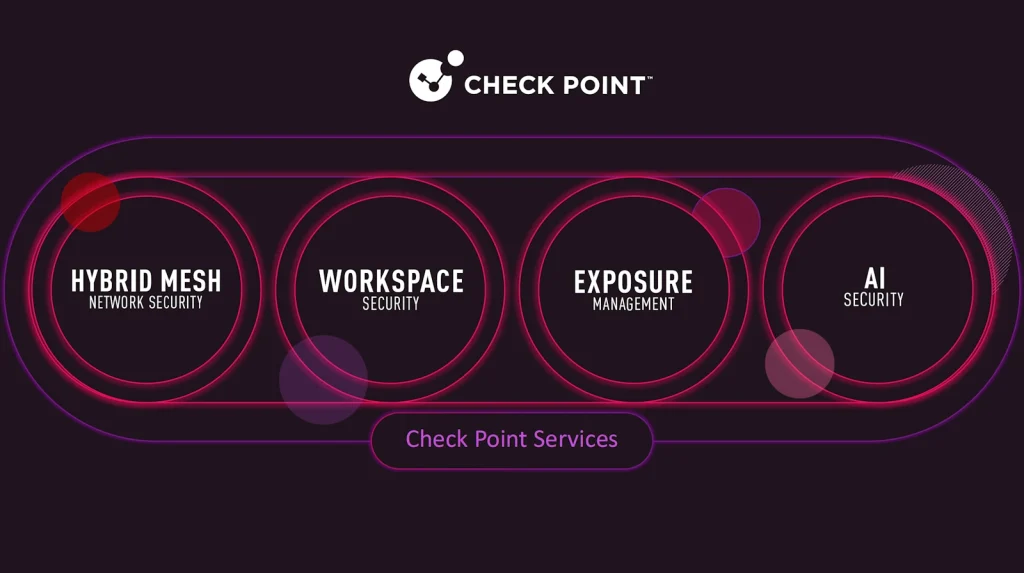
Safetech proposes to organizations in Romania a Hybrid Mesh Security architecture based on Check Point technology. Check Point has been recognized as a Leader in the Gartner Magic Quadrant 2025 for Hybrid Mesh Firewall, with an architecture that integrates several distinct technology components, each addressing a specific need across the scalability and deployment spectrum.
Maestro Hyperscale is the component dedicated to extreme scalability in data centers. By orchestrating multiple Quantum firewalls as a unified system, Maestro enables the creation of a hybrid fabric that spans both on-premises infrastructure and cloud environments. The solution uses proprietary HyperSync technology to ensure 99.999% availability and intelligent traffic balancing, with inspection capability scalable from 60 Gbps to 1,400 Gbps — or up to 3 Tbps for east-west traffic in data centers with latencies below 2 microseconds. In-service upgrades eliminate planned maintenance windows, allowing for continuous operations without interruption.
ElasticXL is a next-generation clustering technology designed to bring Maestro functionality into deployments that don’t require or justify the investment in dedicated orchestrator hardware. Based on the same scalable architecture, ElasticXL uses a Single Management Object (SMO) model: the entire cluster appears to management systems as a single gateway, radically simplifying administration and licensing. Adding a new node to the cluster automatically brings synchronization of configuration and software, without manual intervention. ElasticXL is intended for organizations that want quasi-linear scalability of performance without the architectural complexity associated with Maestro.
VS Next is the advanced Virtual Gateway platform, the successor to the classic Check Point VSX architecture. Designed for environments that require strong logical segmentation on shared hardware, VS Next is intended for service providers, organizations with strict security domain separation requirements, and environments running ElasticXL. Native integration with ElasticXL allows migration from traditional ClusterXL or VSX configurations through a specialized conversion tool, reducing the complexity and operational risk of the transition.
All these components are orchestrated through SmartConsole — the unified management console Check Point — and benefit from ThreatCloud AI intelligence: real-time data from millions of endpoints and more than 150,000 networks, which powers a prevention engine with a 99.9% block rate according to independent Miercom evaluations.
Safetech Innovations Partnership – Check Point
Hybrid mesh security is not a marketing trend or a label applied to an existing solution. It’s a coherent architectural response to a real structural problem: modern organizations operate in distributed environments that traditional security solutions can’t cover uniformly.
But beyond architecture, there is a lesson that practice constantly confirms: technology, no matter how sophisticated, does not implement itself. Check Point provides the raw material — AI-powered prevention engines, distributed architectures, ThreatCloud telemetry, 99.9% block rate. What transforms this technological capacity into real resilience for an organization is the expertise of the one who assembles, sizes and operates it.
Safetech Innovations brings this expertise into practice. Through its end-to-end services and CERT® STI center, Safetech designs the architecture, eliminates fragmented security enforcement, rightly sizes capacity, and operates infrastructure around the clock, turning raw alerts into pragmatic defense decisions.
FAQs
1. What does Hybrid Mesh Security mean?
Hybrid Mesh Security is a security architecture that unifies the protection of on-premises infrastructure with cloud-native security, under a single, centralized point of control. Hybrid mesh architecture treats the entire infrastructure — no matter where it is physically or logically located — as a unified network, governed by consistent policies and complete visibility.
2. Is Hybrid Mesh Security also suitable for medium organizations, not just enterprise?
Yes, the essential criterion is not the size of the company, but the complexity of the infrastructure. Any organization that operates simultaneously on multiple environments—cloud, on-premises, branch offices, remote users—can benefit from hybrid mesh principles, including through accessible configurations like ElasticXL, without dedicated orchestrator hardware.
3. How different is the hybrid mesh firewall from a classic NGFW with centralized management?
The difference is in architecture, not just management. A centralized NGFW manages similar devices from a common console, but security remains location-related. A hybrid mesh firewall unifies radically different forms of deployment — hardware, virtual, cloud-native, FWaaS, containers — under the same policy, with cross-environment visibility. Microsegmentation, CI/CD integration, and application observability have no equivalent in the traditional NGFW model.
4. Does Hybrid Mesh Security automatically mean giving up existing infrastructure?
No. The model is compatible with existing investments. Architectures like Maestro integrate current hardware into scalable clusters without complete replacements. The transition can be done incrementally, adding new resources in parallel with the existing infrastructure, under the same management console.
5. What is the relationship between Hybrid Mesh Security and Zero Trust?
Hybrid Mesh provides the infrastructure foundation for a functioning Zero Trust. Without an architecture that unifies visibility and policy enforcement across all environments, Zero Trust remains a theoretical goal. Hybrid Mesh provides just this platform: consistent policies, micro-segmentation to limit lateral movement, and native integrations with identity (IAM) and detection (XDR) systems.